07.10.2026


Tallinn Airport is embarking on the largest development project in its history, expanding the passenger terminal to accommodate future growth. By 2030, the airport expects to serve nearly 5 million passengers a year — a volume that exceeds the capacity of the current terminal. The terminal expansion is divided into five stages to allow construction in different parts of the building at different times, with works continuing until 2030.
The existing terminal was designed to serve 2.8 million passengers per year, yet today more than 3.5 million people already pass through Tallinn Airport annually. By 2030, the number is projected to reach nearly 5 million. The total estimated cost of the development project is 75 million euros, making it the largest investment in the airport’s history. The exact cost will be determined after all procurement processes have been completed. “Most of the design work has now been finalised. Construction of the first phase inside the terminal has already begun, and the next major construction tender will be announced in mid-December with estimated cost of 50 million auros,” said Riivo Tuvike, Chairman of the Management Board of Tallinn Airport.
“This expansion provides a foundation for future developments, which is why we designed the new volumes to integrate naturally with the existing terminal’s architecture,” explained architect Jaan Kuusemets from Dagopen. “The northern extension and smaller additions continue the terminal’s parapet line and will eventually be tied together with an elegant ribbon façade. The roof shape, overall massing and height are derived from the proportions of the historical terminal, reinterpreted in a contemporary architectural language to create a balanced and context-sensitive composition.”
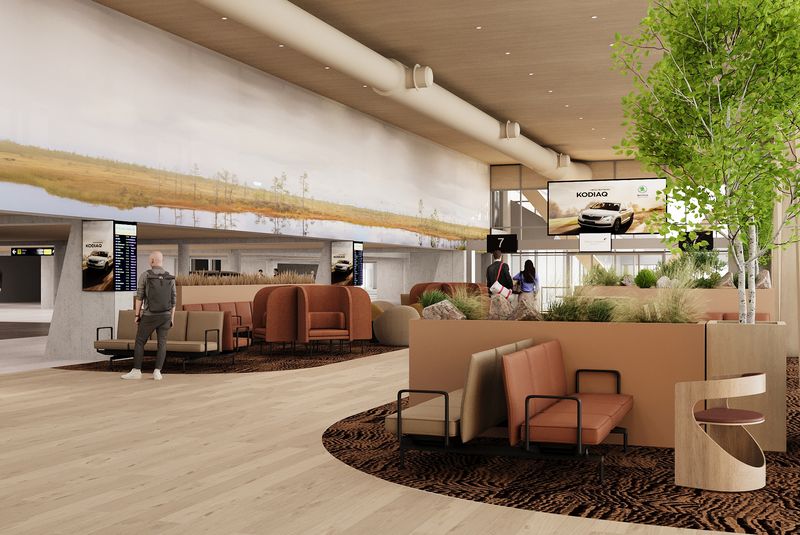
“We are using natural wood and creating spacious, light-filled rooms with generous views towards both the airfield and the city,” Kuusemets added. “The terminal’s internal logistics and spatial planning have been designed in accordance with international standards and address today’s critical bottlenecks in a way that improves both capacity and the overall passenger environment.”
“Tallinn Airport must grow together with Estonia, it needs to be fast, convenient, and innovative, while remaining warm and welcoming,” said Riivo Tuvike. “Many passengers have probably noticed recently that baggage handling has become slower. Although our baggage handling team works efficiently and professionally, the bottleneck lies in an outdated baggage system and limited loading space. Another challenge is our insufficiently sized border control area, where long queues quickly form when several aircraft arrive at once. These and other bottlenecks, along with the need to expand and modernise passenger areas, will all be resolved through this development project.”
According to Tuvike, the main goal of the expansion is to increase the terminal’s capacity so that the growing passenger numbers do not compromise service quality. “We will eliminate the infrastructure bottlenecks that hinder passenger service and implement state-of-the-art technical solutions to ensure fast, convenient, and safe travel,” he added.
The expansion of the passenger terminal is divided into five stages to enable flexible construction planning and phased procurement. “We have already begun work on Stage I, which includes the renovation of the check-in area and the introduction of self-service solutions,” Tuvike noted.
In mid-December, the airport will announce its largest construction tender, seeking a contractor for all remaining stages except Stage IV, which covers the expansion of the security screening area, VIP service area, and retail spaces. “We will announce the tender for the final stage once the works in the border control and arrivals baggage areas have been completed,” added Tuvike.
By 2030, the terminal will be expanded in five phases, adding approximately 16,500 m² of new space and renovating over 18,000 m² of existing terminal areas.

The biggest challenge is carrying out construction while keeping the airport fully operational. “The key question for us is how to build safely and with high quality without compromising the passenger experience. This is a major challenge, but our team is working to ensure smooth service and clear communication about any changes. We kindly ask passengers for understanding — temporary inconveniences, queues, and rerouted pathways are unfortunately unavoidable during construction, but they are essential to deliver a significantly more comfortable and modern airport experience in the future,” said Riivo Tuvike.
By 2030, the renewed areas of Tallinn Airport will reflect the spirit of the world’s cosiest airport — distinctly Estonian, with an emphasis on natural motifs, local flavours, and smart design solutions that blend modern technical innovation with a warm and familiar atmosphere.
Architects: DAGOpen
Interior design: studio ARGUS